Chief AI Officer Salary in 2026: The Complete Compensation Guide
If you're wondering what a Chief AI Officer actually earns in 2026, you're asking the right question at the right time. I've spent the last three decades in tech leadership, deployed over 50 production AI systems, and now advise companies on building their AI leadership teams. The CAIO role has gone from barely existing to one of the most sought-after positions in the C-suite, and compensation has followed.
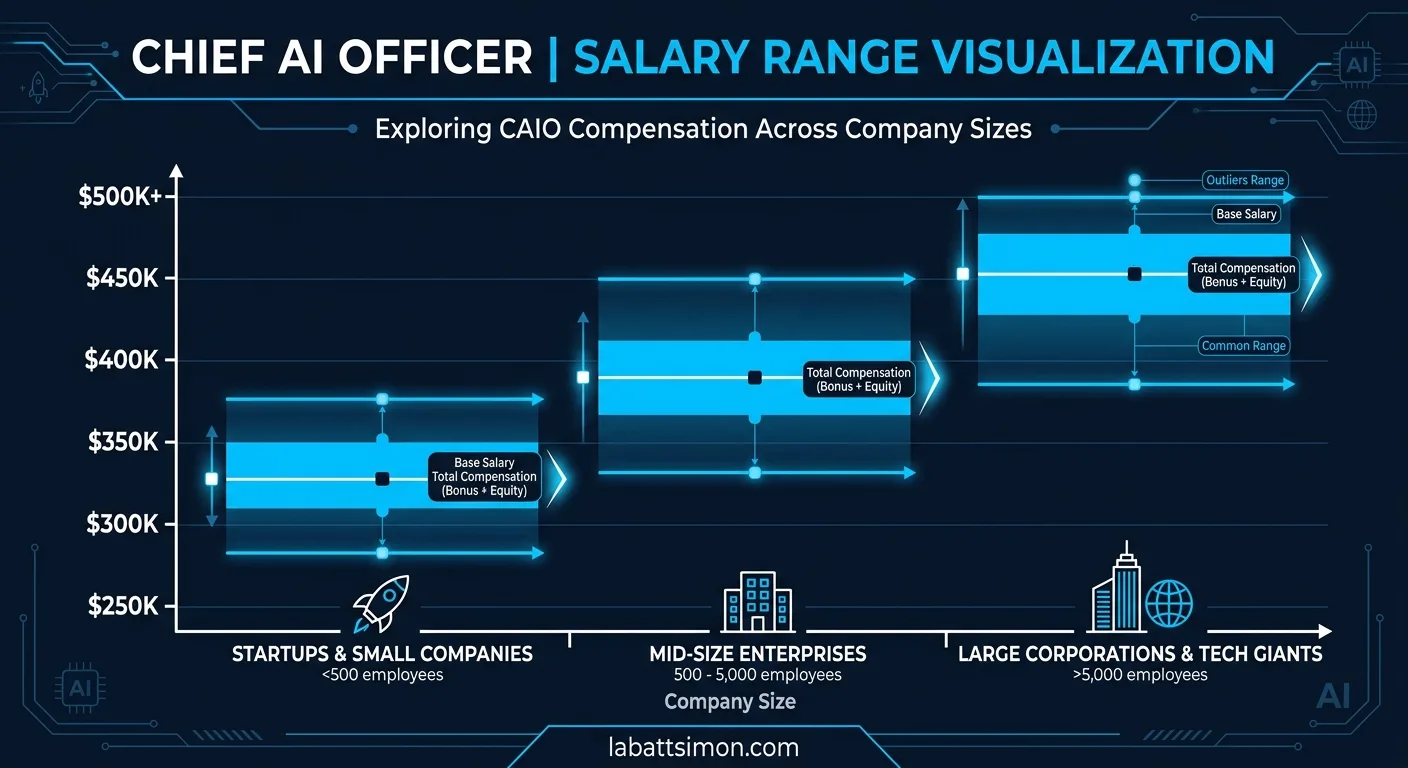
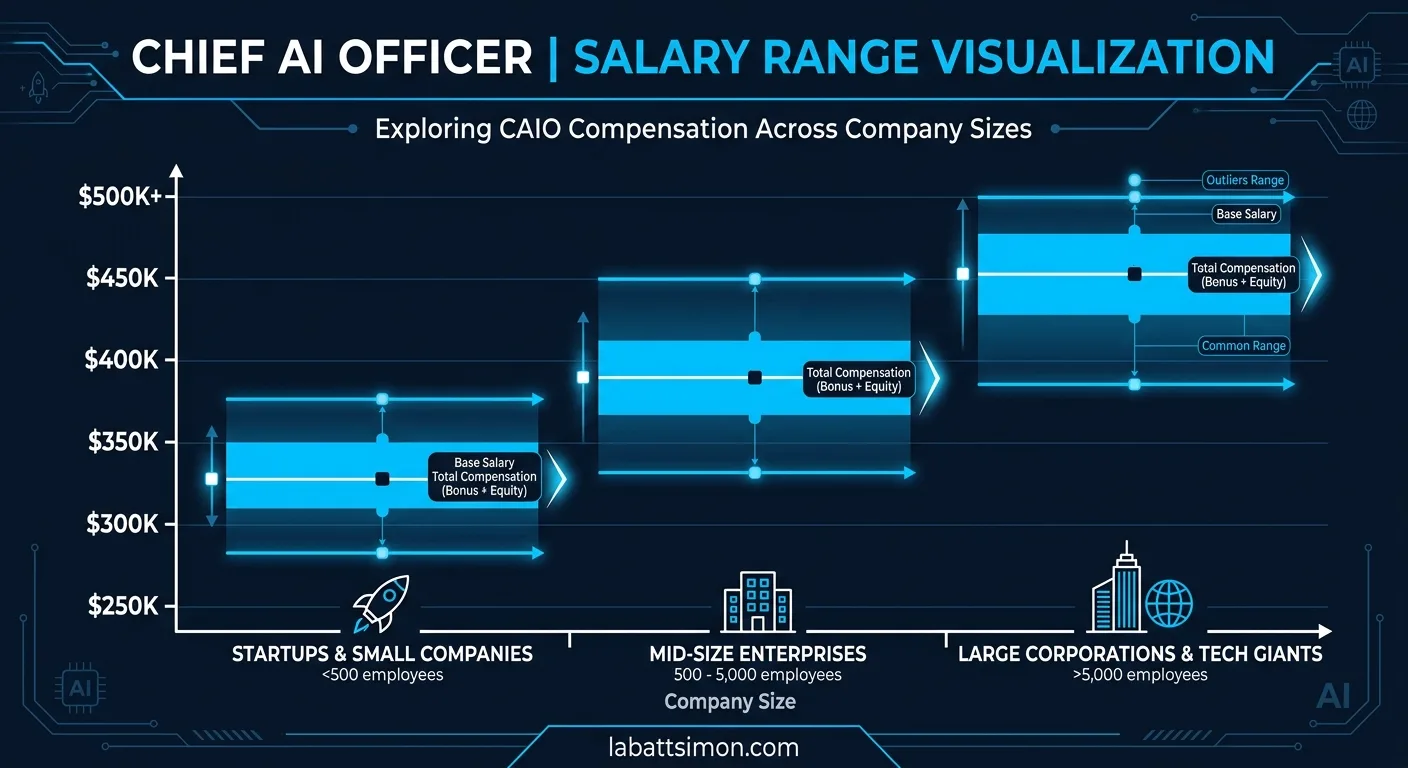
The average Chief AI Officer salary in the United States in 2026 ranges from $250,000 to $600,000 in base pay, with total compensation (including bonuses and equity) reaching $500,000 to $2.5 million or more at Fortune 500 companies. According to Glassdoor, the average base sits around $354,000, while Comparably reports $259,000. The Heidrick & Struggles 2025 Compensation Survey found median total compensation for AI and data executives in the US at $914,000. The spread is wide because the role itself varies enormously depending on company size, industry, and how mature the organization's AI efforts are.
Those numbers probably surprise some people. Others saw this coming a mile away. The reality is that when demand for a skill outpaces supply by the margins we're seeing right now, compensation gets pulled upward fast. And the CAIO talent pool is tiny relative to the number of companies trying to hire one.
Let me walk you through what's actually driving these numbers, what the role looks like day to day, and how to think about CAIO compensation if you're hiring one or trying to become one.
What does a Chief AI Officer actually do?
Before we talk about money, it helps to understand what companies are paying for. The CAIO title sounds straightforward, but the role varies a lot depending on who's hiring.
At its core, a Chief AI Officer is the executive responsible for an organization's entire AI agenda. That means strategy, governance, implementation, risk management, and measuring business outcomes. They sit at the intersection of technology, business strategy, ethics, and organizational change.
Here's what that breaks down to in practice:
AI strategy and operational roadmap. The CAIO decides where AI should be applied across the business, prioritizes use cases by ROI and feasibility, and defines what success looks like over 12 to 36 months. This isn't about chasing shiny objects. It's about connecting AI capability to revenue growth, cost reduction, or competitive advantage.
Governance, risk, and ethics. With the EU AI Act, US executive orders, and a growing patchwork of state and international regulations, someone needs to own compliance. That person is the CAIO. They build governance frameworks, run ethics reviews, and approve high-risk deployments. At regulated companies (financial services, healthcare, government), this alone can justify the role.
Enterprise-wide implementation. (For smaller organizations, see our guide on AI consulting for small businesses.) Plenty of companies have AI pilots. Fewer have AI that actually runs in production at scale. The CAIO is responsible for moving beyond experiments and into real workflows. That means coordinating across engineering, product, operations, legal, and every other function that touches AI.
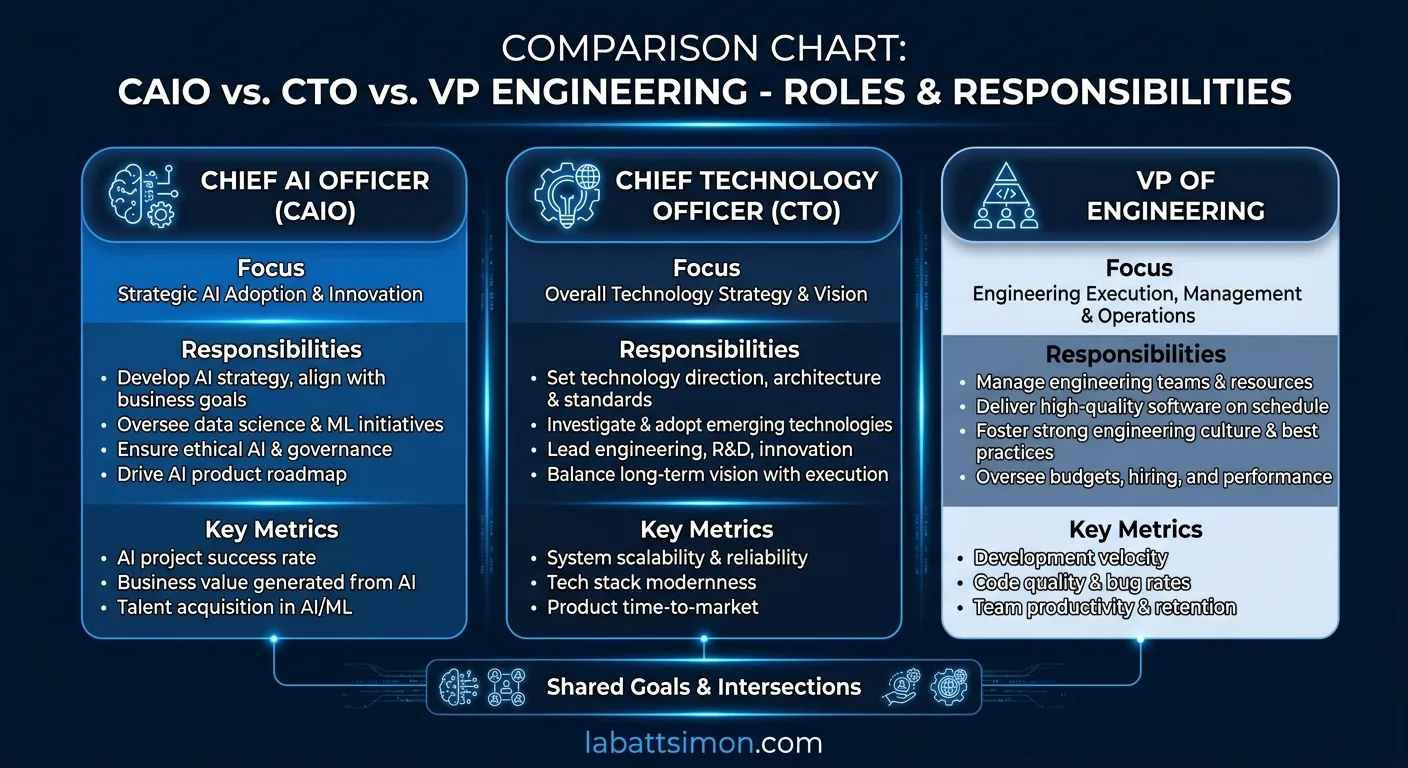
Cross-functional collaboration. The CAIO works with the CTO on infrastructure, the CDO on data quality, the CISO on security, the CHRO on upskilling, and the CFO on budgets. This is a politically complex role that requires influence without always having direct authority.
Culture and upskilling. Most companies are still figuring out how to get their people comfortable with AI. The CAIO typically sponsors training programs, internal AI councils, and communication efforts aimed at building an AI-literate workforce.
About 60% of organizations globally now have some form of dedicated AI executive, according to recent executive search data. That number was below 15% just two years ago. The growth is real, and it's not slowing down.
Chief AI Officer salary by company size
Company size is the single strongest predictor of CAIO compensation. Bigger companies carry more governance complexity, broader AI portfolios, and higher stakes if something goes wrong. Here's what the data shows for 2026:
Company Size | Base Salary | Typical Bonus | Equity | Total Compensation |
|---|---|---|---|---|
Startup (Series A-C) | $250K - $400K | 15-25% of base | 0.5% - 2.0% equity | $400K - $1M |
Scale-up (Series D+) | $350K - $500K | 20-30% of base | 0.25% - 0.75% equity | $600K - $1.5M |
Mid-market ($100M - $1B revenue) | $300K - $450K | 40-60% of base | RSUs common | $500K - $900K |
Enterprise ($1B - $10B revenue) | $400K - $600K | 50-75% of base | Significant RSU grants | $750K - $1.5M |
Fortune 500 | $500K - $750K | 75-100% of base | Large equity packages | $1M - $2.5M+ |
Sources: Rework.com 2026 CAIO Hiring Guide (analysis of 500+ job postings), Heidrick & Struggles 2025 Compensation Survey (318 executives), Glassdoor, Comparably.
A few things jump out from this data.
First, the spread within each tier is wide. A CAIO at a mid-market company overseeing internal process automation earns very differently from one at a same-size company building AI-powered products that generate revenue. Scope matters more than title.
Second, startups compensate differently. Base pay can actually be lower than at established companies, but the equity upside changes the math entirely. A CAIO who joins a Series B startup with 1% equity is making a bet. If that company reaches a $5 billion valuation, that 1% is worth $50 million. The risk-reward profile is totally different from a Fortune 500 package.
Third, bonus targets get aggressive at the enterprise level. A CAIO with a $500K base and a 75% bonus target is looking at $375K in annual performance bonus on top of salary and equity. These are real numbers that real companies are paying in 2026.
Chief AI Officer salary by industry
Industry shapes compensation because it determines the risk profile and potential ROI of AI initiatives. Companies in heavily regulated or data-intensive sectors tend to pay more because the consequences of getting AI wrong are severe.
Industry | Base Salary Range | Total Comp Range | Notes |
|---|---|---|---|
Technology / SaaS | $400K - $700K | $800K - $2.5M | Highest equity component; AI often core to product |
Financial Services | $380K - $650K | $700K - $2.0M | Regulatory complexity drives premium; strong bonus culture |
Healthcare / Life Sciences | $350K - $600K | $650K - $1.5M | Data sensitivity and compliance requirements push pay up |
Consulting / Professional Services | $325K - $550K | $600K - $1.3M | Client-facing AI expertise valued; project-based bonus structures |
Retail / E-commerce | $300K - $500K | $550K - $1.2M | AI applied to supply chain, pricing, personalization |
Manufacturing / Industrial | $300K - $500K | $500K - $1.1M | Operational AI (predictive maintenance, quality) gaining traction |
Energy / Utilities | $300K - $480K | $500K - $1.0M | Critical infrastructure oversight; safety premium |
Government / Public Sector | $180K - $300K | $200K - $400K | Constrained pay scales; some make up for it with stability and benefits |
Sources: Heidrick & Struggles 2025 Compensation Survey, Rework.com, executive recruiter interviews, public job postings analysis.
Technology companies pay the most, and it's not close. The Heidrick survey found that US-based AI executives in the tech sector earned a median total compensation of $1.2 million. Financial services came in second, particularly at large banks and hedge funds where AI directly impacts trading, risk management, and fraud detection.
Healthcare is catching up fast. Between the explosion of AI in drug discovery, clinical decision support, and administrative automation, healthcare organizations are competing for the same talent pool as tech companies. They're adjusting compensation accordingly.
Government remains the outlier. Federal and state pay scales limit what agencies can offer, which is why many experienced AI leaders pass on government CAIO roles despite the meaningful work. The ones who take these positions are typically motivated by mission rather than money.
What drives CAIO salary differences
Not all CAIO roles are created equal. Two people with the same title at companies of similar size can earn vastly different amounts. Here's what actually moves the needle:
Scope of responsibility. A CAIO who owns both internal AI operations and customer-facing AI products will out-earn one who only handles internal tools. The more business functions that report up through the CAIO, the higher the compensation.
Company AI maturity. Counterintuitively, companies that already have some AI infrastructure in place often pay more than companies starting from scratch. They're hiring a CAIO to drive transformation and extract value from existing investments, not to build basic capabilities. That's a harder job, and it's priced accordingly.
Prior results. A track record of AI projects that generated measurable revenue, reduced costs, or successfully navigated regulatory challenges adds 15-25% to offers. CAIOs who can point to specific outcomes ("I built an AI system that reduced fraud losses by $40M annually") command premium packages.
Regulatory complexity. Heavily regulated industries (healthcare, finance, defense) pay premiums for CAIOs who understand compliance. Knowing how to build AI systems that satisfy both business requirements and regulatory scrutiny is a rare combination.
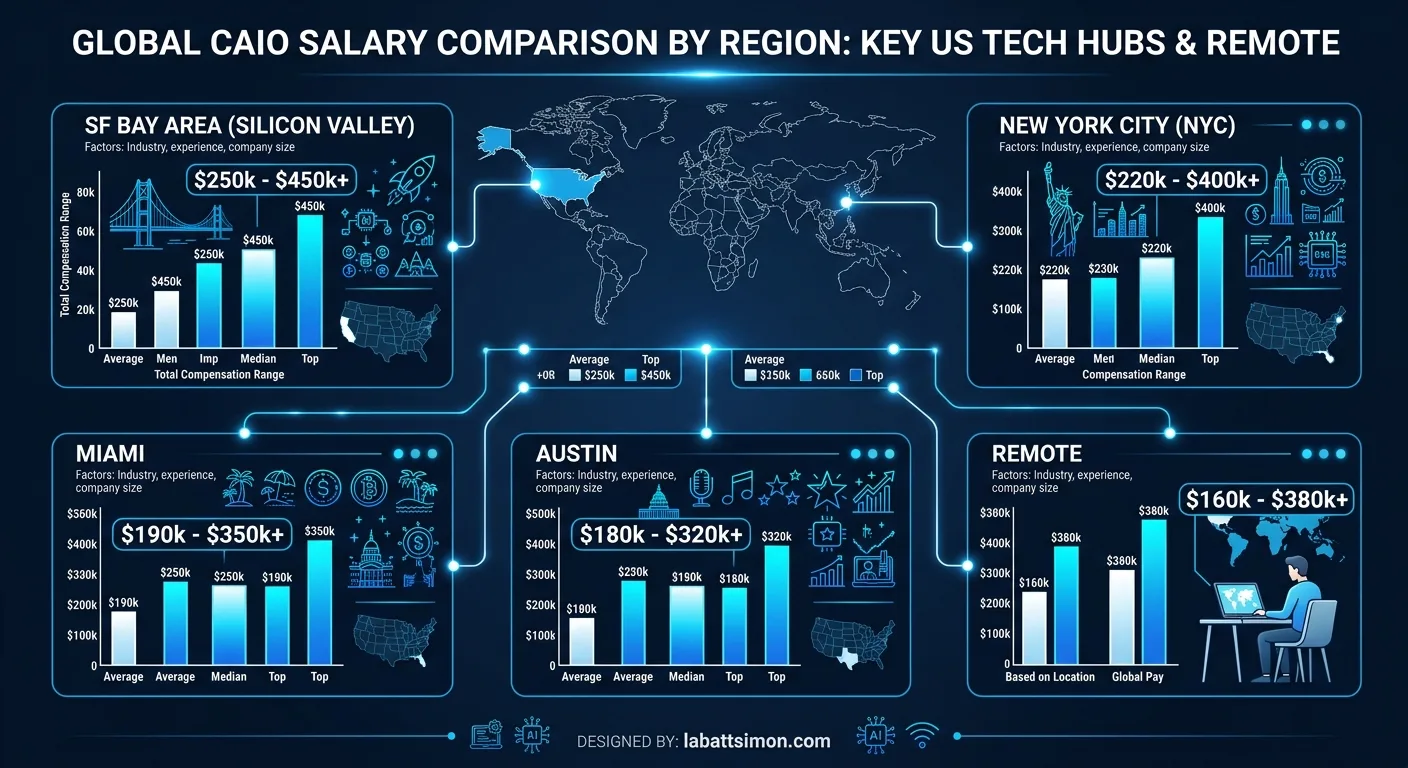
Geography. San Francisco Bay Area roles pay 30-45% above national averages. New York adds 25-35%. Seattle and Boston run 20-25% higher. Remote roles are becoming more common, but many companies still pay a location premium for executives they want on-site.
Reporting line. CAIOs who report directly to the CEO generally earn more than those who report to the CTO or COO. Direct CEO reporting signals that the board considers AI a strategic priority, and compensation reflects that positioning.
Equity, bonuses, and the rest of the compensation picture
Base salary is just the starting point for CAIO compensation. The full package typically includes several additional components that can double or triple the headline number.

Annual performance bonus. Most CAIO roles include a target bonus of 20-100% of base salary, depending on company size and industry. Payouts are typically tied to a mix of company financial performance and individual or functional goals like AI adoption rates, model performance metrics, or cost savings from AI initiatives.
Equity and stock awards. At publicly traded companies, RSUs (Restricted Stock Units) are the standard equity vehicle. Grants typically vest over 3-4 years, with annual refresh grants common for retention. At pre-IPO companies, stock options or direct equity stakes are the norm. The Heidrick survey found that 38% of US-based AI executives received annual equity in the form of RSUs, while 58% received sign-on equity.
Signing bonuses. For senior hires, especially those being recruited from competitors or from a position of strength, signing bonuses of $50K to $200K are standard. Some Fortune 500 companies go higher for exceptional candidates.
Retention bonuses. Given the scarcity of qualified CAIOs and the cost of turnover at this level, many companies layer in retention bonuses tied to 2-3 year milestones. These can range from $100K to $500K, paid out at specific anniversary dates.
Research and development budgets. While not direct compensation, the size of the AI budget a CAIO controls affects the role's attractiveness. A CAIO with a $50M annual AI budget has more room to deliver results (and earn performance bonuses) than one with $2M.
Executive benefits. Standard benefits, plus executive healthcare, financial planning services, and generous professional development budgets ($50K-$200K annually for conferences, courses, and AI hardware).
Here's a practical example. A CAIO at a $5B-revenue financial services company might have:
Base salary: $450,000
Target bonus (60% of base): $270,000
Annual RSU grant: $400,000 (vesting over 4 years, so ~$100K in year-one value)
Signing bonus: $150,000
Total year-one compensation: roughly $970,000
That's not an outlier. That's a competitive mid-range package for this profile in 2026.
CAIO vs. CTO: compensation compared
The relationship between the CAIO and CTO roles is one of the most common questions I hear. Are they the same job with different names? How does the pay compare?
They're not the same job. The CTO owns the overall technology strategy: infrastructure, software development, architecture, cybersecurity, and keeping the technical engine running. The CAIO focuses specifically on AI strategy, governance, implementation, and business outcomes. In practice, the CTO ensures the foundation works; the CAIO builds the AI layer on top of it.
Here's how compensation stacks up across the C-suite for 2026:
Role | Average Base Salary | Average Total Compensation | vs. CAIO |
|---|---|---|---|
CEO | $700K | $2.5M | +40% above CAIO |
CFO | $450K | $1.2M | +10% above CAIO |
CAIO | $400K | $1.0M | Baseline |
CMO | $375K | $850K | 15% below CAIO |
CTO | $350K | $750K | 15% below CAIO |
CDO (Chief Data Officer) | $350K | $800K | 20% below CAIO |
CHRO | $325K | $700K | 30% below CAIO |
Sources: Rework.com 2026 analysis, Glassdoor, industry compensation surveys.
The CAIO out-earns the CTO at most organizations. That might seem counterintuitive, since the CTO role has existed for decades and the CAIO is relatively new. But it comes down to supply and demand. There are far more qualified CTOs than qualified CAIOs, and the urgency around AI adoption has pushed CAIO compensation above traditional tech leadership roles.
There's another factor at play: scope. The CTO manages an established function with known processes. The CAIO is often building something new, which carries more risk and ambiguity. Companies compensate for that uncertainty.
That said, at AI-native companies where the CTO is essentially doing CAIO work (because the entire product is AI), the distinction blurs and CTO compensation can match or exceed these CAIO numbers.
How to become a Chief AI Officer
If you're reading this and thinking about the CAIO career path, here's what I've seen work for people who successfully made the transition. This isn't theoretical. It's based on watching dozens of AI leaders rise into the role over the past few years.
Build deep AI expertise, but don't stop there
A strong technical foundation is table stakes. Most CAIOs have backgrounds in machine learning, data science, or AI engineering. Many hold advanced degrees in computer science, statistics, or related fields. But technical chops alone won't get you there.
The CAIOs who succeed are the ones who can explain a model's business impact in plain language to a room full of executives who don't know (and don't care) what a transformer architecture is. Technical fluency is required. Technical obsession will hold you back.
Own real business outcomes
This is where most aspiring CAIOs fall short. They can point to models they've built, papers they've published, or systems they've deployed. What they can't always articulate is the business result.
"I built a fraud detection model" is less compelling than "I built a fraud detection model that reduced chargebacks by $25M annually while maintaining a false-positive rate below 2%." Quantify everything. Revenue generated, costs reduced, risks mitigated, time saved. That's what boards care about.
Move from building to leading
There's a career inflection point where you stop being the person who builds the AI and start being the person who decides where AI should be built. That transition, from individual contributor or team lead to strategic leader, is the hardest part of the CAIO path.
It typically looks like this: AI Engineer or Data Scientist, then Director of AI or ML, then VP of AI, then CAIO. The whole journey usually takes 10-15 years. Some people make it faster, especially if they're at a company where AI is central to the business model.
Get governance experience early
This is the differentiator that most people miss. AI governance, ethics, and compliance expertise is what separates a strong VP of AI from a CAIO candidate. With regulatory requirements intensifying globally, companies need CAIOs who can navigate the EU AI Act, NIST AI Risk Management Framework, and whatever comes next.
Volunteer for ethics committees. Join AI governance working groups. Build risk assessment frameworks for AI deployments. This experience is rare and valuable.
Develop C-suite communication skills
You'll spend a surprising amount of your time as CAIO talking to people who don't have technical backgrounds: board members, investors, business unit leaders, regulators. The ability to translate complex AI concepts into clear, decision-ready language is non-negotiable.
Practice building board-ready presentations. Frame AI decisions as trade-offs with clear recommendations, not open-ended technical explanations. This is a learnable skill, but it takes deliberate effort.
Consider the fractional route
Not every CAIO job is full-time. The fractional Chief AI Officer model is growing rapidly, especially among mid-market companies that need strategic AI leadership but can't justify (or afford) a full-time executive hire. Fractional CAIOs typically work with 2-4 companies simultaneously, spending 1-2 days per week at each.
Compensation for fractional CAIOs ranges from $5,000 to $20,000 per month per engagement, depending on scope. A fractional CAIO working with three companies might earn $25K-$50K monthly ($300K-$600K annually) while maintaining more control over their schedule and choosing which problems they tackle.
This is a path I'm seeing more experienced AI leaders take, especially those who've already done the full-time CAIO thing and want the variety of working across multiple industries and company stages.
The market outlook for CAIO compensation
CAIO salaries are not going down anytime soon. Here's why:
Demand keeps growing. CAIO job postings have grown roughly 400% since 2023, and the pace isn't slowing. A recent survey from Heidrick & Struggles found that two-thirds of executives expect most organizations will have a CAIO within the next two years. That's a lot of new positions chasing a small talent pool.
Supply remains constrained. The ideal CAIO candidate combines deep technical AI knowledge, business strategy experience, governance expertise, and leadership ability. People who check all those boxes are genuinely rare. Many companies have been rebranding existing roles (CDO, VP of Data Science) as CAIO without adding the scope or compensation, but this creates confusion rather than supply.
AI budgets are expanding. As organizations move beyond pilots into production AI, the stakes (and budgets) get bigger. Bigger budgets mean more accountability, more complexity, and higher compensation for the person running the show.
Regulatory pressure is increasing. The EU AI Act is now in effect. US federal agencies are implementing their own AI governance requirements. State-level AI legislation is multiplying. Every new rule creates more demand for leaders who understand compliance at the intersection of AI and business.
I expect CAIO base salaries to continue climbing 10-15% annually through at least 2028. Total compensation growth will be even faster as equity packages get richer in response to retention pressure.
A note on the data
A word of caution about CAIO salary data. This is still a new role, and the data is messy. ZipRecruiter, for example, reports an average CAIO salary around $151,000, but their dataset appears to mix in junior AI roles and non-executive positions. Glassdoor and Comparably produce wildly different numbers ($354K vs. $259K) depending on how they define the role.
The most reliable data I've found comes from executive search firms like Heidrick & Struggles, which survey actual executives in these roles, and from analysis of real job postings at named companies. The numbers in this article are synthesized from multiple sources and cross-referenced against what I'm seeing in real compensation conversations.
If someone quotes you a CAIO salary that seems too low or too high, ask: what type of company? What scope? What level? Those details explain 90% of the variation.
Frequently Asked Questions
The average Chief AI Officer salary in the United States in 2026 ranges from 80,000 to 50,000 in base compensation, depending on company size and location. Total compensation including equity and bonuses can reach 00,000 to 00,000 at large enterprises.
CAIO base salaries are roughly 10 to 20 percent higher than CTO salaries at comparable companies, reflecting the scarcity of qualified candidates. CTOs at mid-market companies average 50,000 to 50,000, while CAIOs at similar companies average 80,000 to 00,000.
Most CAIOs have a combination of technical depth in machine learning or data science, plus significant business leadership experience. Common backgrounds include VP of Engineering, VP of Data Science, or senior roles at AI-focused companies. An advanced degree in computer science or a related field is common but not universal.
Yes. At venture-backed companies, CAIO equity packages typically range from 0.5% to 2.0% depending on stage and company size. At public companies, RSU grants commonly add $200,000 to $500,000 in annual equity value. Equity is often the largest component of total compensation.
Financial services and technology companies pay the highest CAIO salaries, with total compensation often exceeding $600,000. Healthcare and pharmaceutical companies are close behind due to the complexity of AI regulation in those sectors. Retail and manufacturing tend to pay 15 to 25 percent less.
The role is becoming permanent. As AI moves from experimental to core business infrastructure, companies need dedicated executive leadership for AI strategy, governance, and implementation. The number of CAIO job postings has grown over 300% since 2023.
A fractional CAIO works part-time with a company, typically 8 to 20 hours per week, providing the same strategic leadership as a full-time CAIO at a fraction of the cost. Fractional CAIOs typically earn $10,000 to $25,000 per month per client engagement, often working with 2 to 4 clients simultaneously.