AI Consulting for Small Businesses: What It Actually Costs, What You Get, and Whether It's Worth It
If you run a small business and you've been hearing about AI for the last three years, you're probably somewhere between curious and overwhelmed. Maybe you've played with ChatGPT. Maybe someone on your team already uses Copilot. But there's a gap between "we use AI sometimes" and "AI is actually making us money," and that gap is where AI consulting lives.
AI consulting for small businesses is the process of bringing in an outside expert (or team) to figure out where AI fits in your specific operations, build or configure the right tools, and make sure your people can actually use them. It's not about chasing trends. It's about finding the three or four places where automation or intelligence can save you real time and money, then doing those things well.
That's it. No magic. No revolution. Just applied problem-solving with newer tools.
Why small businesses are hiring AI consultants right now
The short version: the cost of not doing it is starting to hurt.
A 2025 McKinsey survey found that 72% of companies now use AI in at least one business function, up from 55% in 2023. But here's the part that matters for small businesses: the companies seeing actual ROI aren't the ones who bought the most expensive tools. They're the ones who picked the right problems to solve first.
Small businesses have a specific advantage here that most people don't talk about. You're closer to your operations. A 15-person company can identify a bottleneck on Monday, test an AI solution on Wednesday, and roll it out by Friday. A 15,000-person company needs six months of stakeholder meetings to get approval for a pilot.
The problem is that most small business owners don't have time to evaluate which AI tools are real and which are vaporware. They don't know the difference between a fine-tuned model and a prompt template someone is selling for $2,000/month. That knowledge gap is expensive. And that's what a good AI consultant fills.
What's changed in 2026
Three things are different this year:
AI agent frameworks have matured. Tools like CrewAI, LangGraph, and AutoGen now work reliably enough for production use. Your consultant isn't building from scratch anymore. They're assembling and configuring tested components.
Costs have dropped. Running GPT-4-class models through API costs roughly 80% less than it did in early 2024. A workflow that would have cost $500/month in API fees now runs for under $100.
The talent pool has expanded. Two years ago, you needed someone with a machine learning PhD to do this work. Now, experienced software engineers and business analysts with AI training can handle most small business use cases. That means more competition among consultants and better rates for you.
What an AI consultant actually does (week by week)
I want to be concrete here, because "AI consulting" can mean almost anything. Here's what a typical 8-week engagement looks like for a small business:
Weeks 1-2: Discovery and audit
The consultant interviews your team, watches how work actually happens (not how it's supposed to happen), and identifies where time and money are being wasted. They look at your existing software stack, your data, and your workflows. The deliverable is usually a prioritized list of opportunities with rough ROI estimates.
Weeks 3-4: Solution design
For the top 2-3 opportunities, the consultant designs specific solutions. This includes which tools to use, how they connect to your existing systems, what data you need, and what the expected cost savings or revenue impact will be. You review this together and pick what to build first.
Weeks 5-7: Build and test
The consultant builds or configures the solution, tests it with real data, and trains your team on how to use it. This is where most of the hands-on technical work happens.
Week 8: Handoff and documentation
Everything gets documented. Your team gets trained. The consultant creates a maintenance guide so you're not dependent on them forever. Good consultants actively try to make themselves unnecessary.
Not every engagement follows this exact pattern. Some are shorter (a 2-week audit only). Some are ongoing (a fractional AI officer who works 10 hours per month). But this gives you a realistic picture of what the work involves.
How much AI consulting costs for small businesses
Let's talk money. These are real ranges based on current market rates in the US, as of early 2026:
Service type | Typical cost range | What you get | Best for |
|---|---|---|---|
AI readiness audit | $2,000 - $7,500 | Assessment of your operations, prioritized list of AI opportunities, and a structured 90-day roadmap | Companies that want to understand their options before committing |
Single workflow automation | $5,000 - $15,000 | One fully built and deployed AI-powered workflow (e.g., automated email triage, document processing) | Companies with a specific pain point they've already identified |
Full 8-week engagement | $15,000 - $40,000 | Discovery, design, build, and deployment of 2-3 AI solutions with training and documentation | Companies ready to make AI a real part of their operations |
Fractional AI officer | $2,000 - $8,000/month | Ongoing strategic guidance, vendor evaluation, team training, and project oversight (typically 8-15 hours/month) | Companies that want continuous AI leadership without a full-time hire |
Hourly consulting | $150 - $350/hour | Ad-hoc expertise for specific questions, reviews, or troubleshooting | Companies that need occasional expert input |
A few things to note about these numbers:
The low end of each range usually means a solo consultant or small firm. The high end usually means a boutique agency with a team. Both can be good. The solo consultant often gives you more senior attention per dollar. The agency gives you more bandwidth and diverse skills.
Beware of anyone charging less than $100/hour. AI consulting requires genuine expertise, and deep discounts usually mean the "consultant" is learning on your dime.
Also beware of anyone who won't give you a fixed project price. Hourly billing creates the wrong incentives in consulting. You want someone motivated to solve your problem efficiently, not to maximize billable hours.
Where AI consulting makes the biggest difference for small businesses
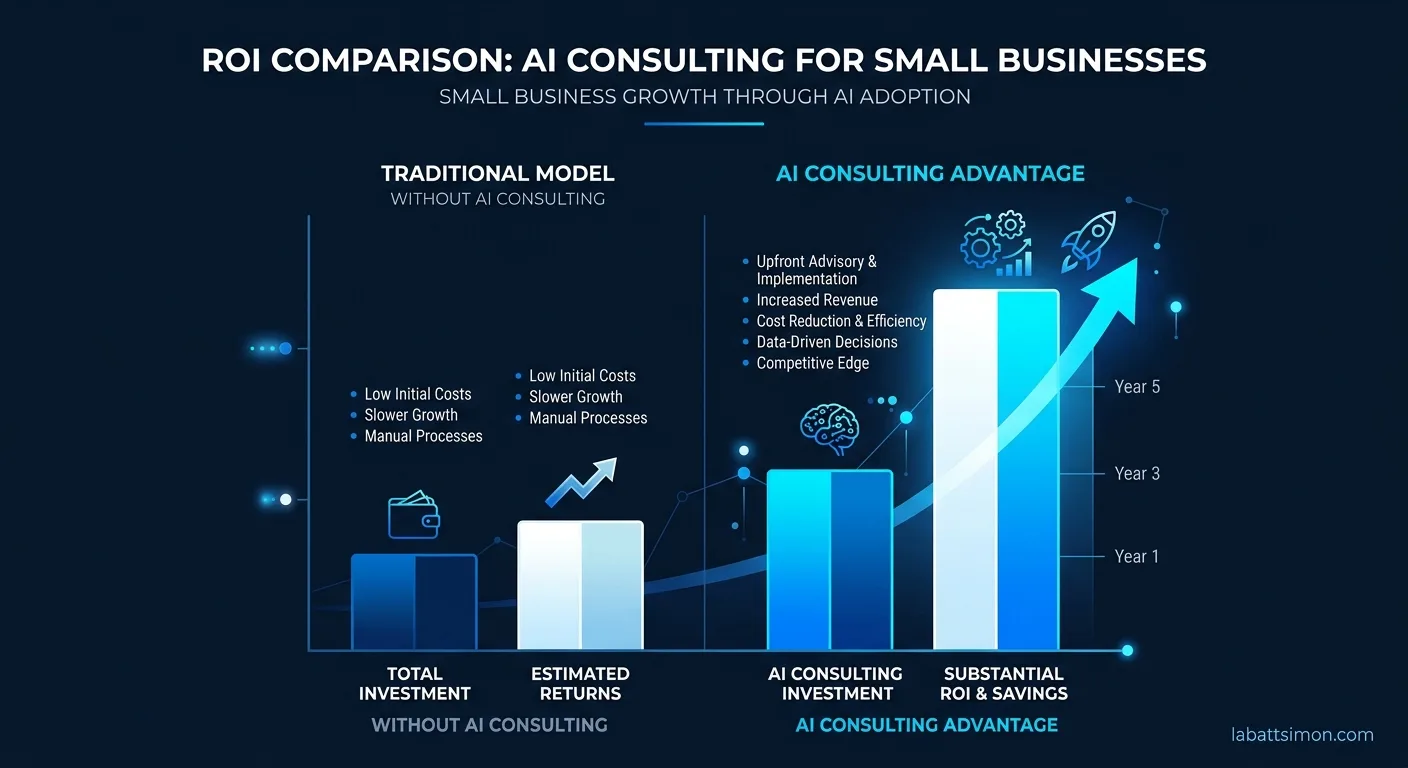
Not every business function benefits equally from AI. Based on what I've seen working with dozens of small businesses, here's where the ROI tends to be highest:
Customer service and support
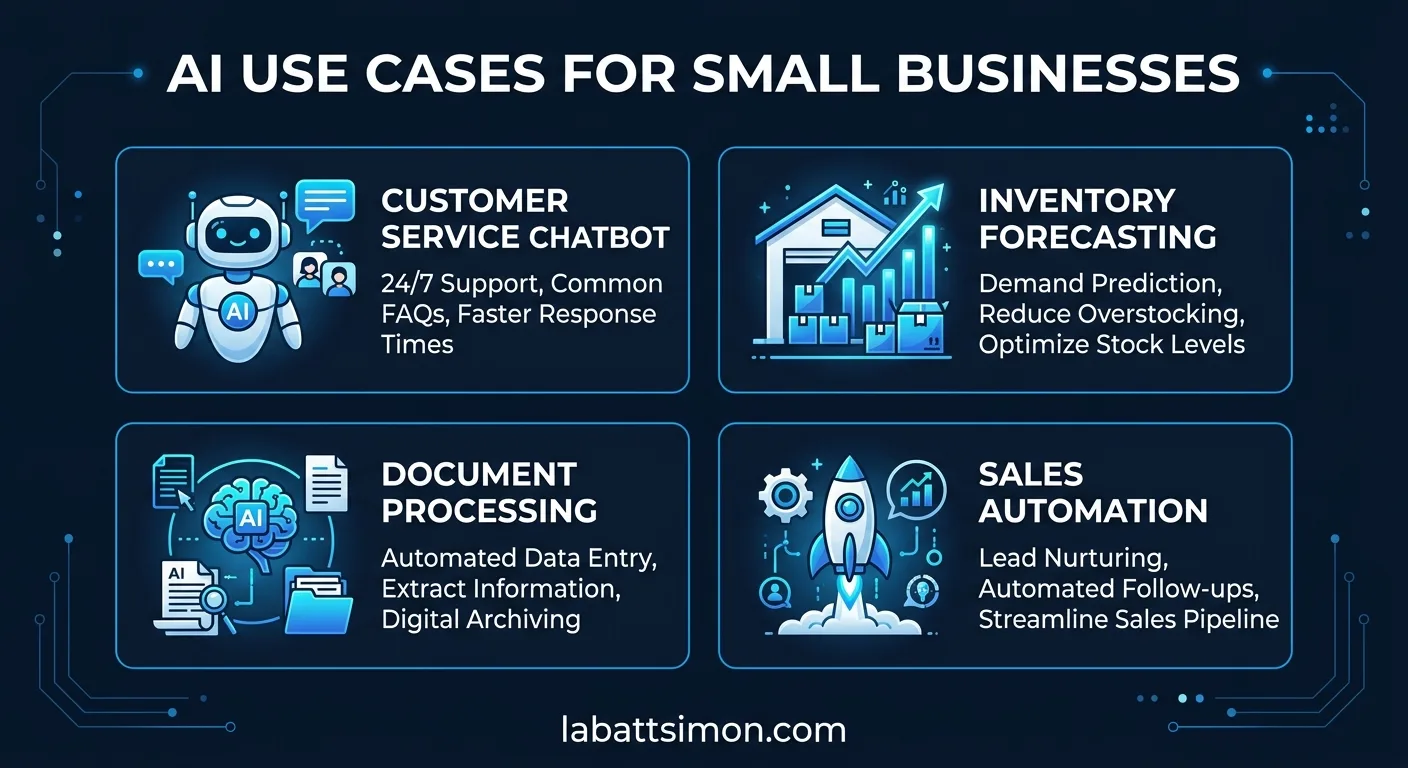
This is the low-hanging fruit. AI can handle 40-60% of routine customer inquiries without human intervention, and it can help your support team resolve the remaining ones faster. The tools here are mature, the setup is relatively straightforward, and the cost savings are immediate.
A 2025 Zendesk benchmark report found that small businesses using AI-assisted support reduced their average response time by 62% and cut support costs by roughly 30%. Those numbers are real, but they depend heavily on having clean, organized knowledge bases for the AI to pull from. If your support docs are a mess, fixing that comes first.
Sales and lead qualification
This one surprises people. AI is genuinely good at looking at your historical sales data, figuring out which leads are most likely to convert, and helping your sales team focus their time on the right prospects. For businesses with more than 100 leads per month, this typically increases conversion rates by 15-25%.
The more specific application: AI can draft personalized outreach emails based on a prospect's industry, company size, and the specific problems they're likely to have. Your sales rep still reviews and sends them, but the drafting time drops from 15 minutes per email to 2 minutes.
Back-office operations
Invoice processing, expense categorization, appointment scheduling, data entry from forms. All of these are repetitive, rule-based tasks that AI handles well. The typical small business spends 20-30 hours per week on this kind of administrative work. AI can cut that by half.
Content and marketing
AI won't replace your marketing strategy (and you should be suspicious of anyone who claims it will). But it's very effective at scaling content production, personalizing email campaigns, analyzing which content performs well and why, and handling social media scheduling. The key word is "scaling," not "replacing." You still need a human who understands your brand and your customers.
Inventory and demand forecasting
For product-based businesses, AI-powered demand forecasting can reduce overstock by 20-30% and stockouts by 30-40%. This requires historical sales data (ideally 2+ years) and a competent consultant who understands your supply chain. The upfront investment pays back fast if you're currently losing money on dead inventory.
The simulated case study: TechNova Solutions
To show how this works in practice, let me walk through a simulated example based on a composite of real engagements. The company, the numbers, and the specific outcomes are illustrative, not pulled from a real client.
Please note: this is a simulated case study for educational purposes. TechNova Solutions is a fictional company.
The situation
TechNova Solutions is a mid-sized tech company with about 80 employees. Their customer support team of 6 people was handling around 400 tickets per week, mostly through email and a basic helpdesk system. Average response time: 14 hours. Customer satisfaction (CSAT) scores had been dropping for three consecutive quarters, landing at 72%.
Their sales team of 8 reps was spending roughly 40% of their time on administrative tasks: logging calls, updating CRM records, writing follow-up emails, and generating proposals. They were closing 18% of qualified leads.
What happened
An AI consultant ran a two-week discovery process and identified three high-value opportunities:
AI-powered ticket triage and response drafting for the support team
Automated CRM updates and email drafting for the sales team
Meeting transcription and action-item extraction for the whole company
The consultant built and deployed all three over six weeks.
The results (simulated)
Metric | Before | After (90 days) | Change |
|---|---|---|---|
Average support response time | 14 hours | 4.2 hours | -70% |
Customer satisfaction (CSAT) | 72% | 87% | +15 points |
Support tickets handled per agent per day | 12 | 22 | +83% |
Sales admin time per rep per week | 16 hours | 6 hours | -63% |
Lead-to-close conversion rate | 18% | 24% | +6 points |
Monthly meeting time spent on recap/follow-up | 30 hours (company-wide) | 8 hours | -73% |
The total consulting engagement cost was $32,000. The estimated annual savings from reduced support hiring needs and increased sales productivity was roughly $180,000. That's a payback period of about two months.
Again: these numbers are simulated. Real outcomes vary based on your starting point, your data quality, and how well your team adopts the new tools. But the magnitude is realistic. I've seen similar results in actual engagements.
How to evaluate and hire an AI consultant
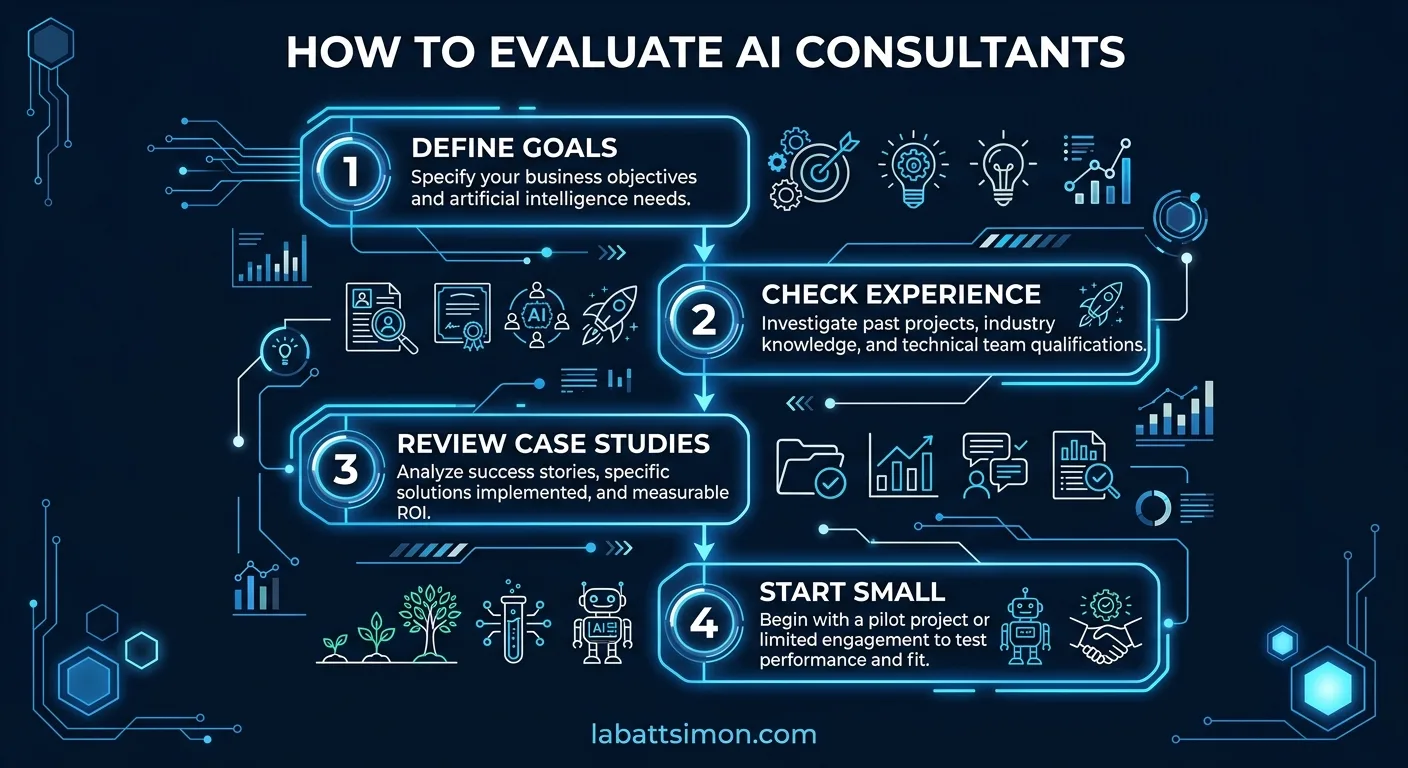
This is where a lot of small businesses go wrong. The AI consulting market is noisy right now. For larger organizations, generative AI consulting services offer a different scope, but the vetting principles are the same. The market. Here's how to separate the real practitioners from the resume-padding crowd:
Questions to ask during the sales process
"Can you walk me through a specific project you completed for a business similar to mine?" If they can't get specific, that's a red flag. You want someone who has actually done the work, not someone who has read about it.
"What's your recommended tech stack for my use case, and why?" Good consultants have opinions about tools. They should be able to explain trade-offs between options without defaulting to "it depends" for everything.
"What happens when the engagement ends? How do I maintain this without you?" This question reveals their business model. If they seem uncomfortable with the idea of you not needing them anymore, they're optimizing for recurring revenue, not your outcomes.
"What data do you need from me, and what if I don't have it?" AI projects live and die on data quality. An experienced consultant will ask about your data early and set realistic expectations about what's possible with what you have.
"What's the most common reason an AI project fails for a business like mine?" Anyone who says "they don't fail" is lying. Good consultants will talk about adoption challenges, data quality issues, or scope creep.
Red flags to watch for
They promise specific ROI numbers before understanding your business
They push proprietary tools that lock you into their ecosystem
They can't explain what they'd build in plain language (hiding behind jargon is a bad sign)
They have no references from businesses your size (enterprise experience doesn't translate)
They quote unusually low prices (the work requires real expertise, and expertise costs money)
Green flags
They ask more questions than they answer in the first meeting
They're transparent about what AI can't do in your situation
They have case studies with measurable outcomes (not just "we helped company X with AI")
They propose starting small and expanding based on results
They include training and documentation as standard parts of every engagement
The fractional AI officer model
If you're not ready for a full engagement but you know you need ongoing AI guidance, the fractional model is worth considering. A fractional AI officer (sometimes called a fractional CAIO, for Chief AI Officer) works with your company part-time, typically 8-15 hours per month.
What they do:
Evaluate new AI tools and features as they come out (this landscape changes monthly)
Train your team on effective AI usage
Oversee AI projects and vendor relationships
Keep your AI strategy aligned with your business goals
Make sure you're not paying for tools you don't use or need
This model works well for businesses with 10-100 employees that have already completed an initial AI implementation and want to keep progressing without hiring a full-time AI leader. At $2,000-$8,000/month, it's a fraction of what a full-time Chief AI Officer would cost (median salary: around $250,000/year plus benefits). If you want to see what a fractional Chief AI Officer engagement looks like in practice, including scope, deliverables, and typical timelines, that page breaks it all down.
Common mistakes small businesses make with AI
I keep seeing the same patterns. Here are the ones that cost the most:
Starting with the technology instead of the problem. "We need to use AI" is not a business objective. "We need to reduce support response time from 14 hours to under 4 hours" is. Start with the problem, then figure out if AI is the right solution. Sometimes it's not.
Trying to do everything at once. Pick one or two high-impact, well-defined problems first. Get a win. Build confidence. Then expand. Companies that try to "AI-ify" everything simultaneously almost always end up with nothing working well.
Ignoring the people side. The technology is the easy part. Getting your team to actually use the new tools, trust the outputs, and change their workflows is the hard part. Budget time and money for training and change management. If you skip this, your expensive AI implementation will sit unused.
Not measuring before you start. If you don't know your current numbers (response times, conversion rates, hours spent on tasks), you can't measure improvement. Baseline everything before the AI engagement begins.
Choosing the cheapest option. I get it. Budgets are tight. But hiring an inexperienced consultant who delivers a half-working solution that your team hates is more expensive than hiring an experienced one who gets it right the first time.
What to expect in terms of timeline and ROI
Here's a realistic timeline for a small business AI initiative:
Weeks 1-2: Discovery and planning. No visible changes yet.
Weeks 3-6: Build and configuration. You'll start seeing prototypes.
Weeks 6-8: Testing and training. Your team starts using the tools.
Months 3-4: You'll have enough data to measure real impact.
Month 6: Full ROI picture becomes clear.
Most small businesses that commit to a focused AI engagement see positive ROI within 3-6 months. The median is around 4 months based on industry surveys from Deloitte and McKinsey. But "positive ROI" can mean a lot of things. A $20,000 engagement that saves you $30,000/year is positive ROI, but it's not life-changing. A $35,000 engagement that saves you $180,000/year changes how you run your business.
The difference between those two outcomes usually comes down to picking the right problems to solve and having a consultant who understands your specific operations well enough to build something your team will actually adopt.
AI consulting vs. doing it yourself
Maybe you're thinking: "Can't I just figure this out on my own?"
Honestly, maybe. If you or someone on your team has the technical skill, the time, and the willingness to spend 3-6 months learning, testing, and iterating, you can build effective AI solutions without a consultant.
The trade-off is straightforward:
Do it yourself if:
You have a technical co-founder or technical team member with free capacity
Your use case is well-defined and standard (like "add a chatbot to our website")
You're comfortable with a longer timeline
Your budget is under $5,000
Hire a consultant if:
You need results in weeks, not months
Your use case involves integrating AI with existing systems
You're not sure which problems to solve first
You've already tried doing it yourself and hit walls
The opportunity cost of your time is high
There's no shame in either approach. Just be honest about what you have and what you need.
One middle ground that works well: hire a consultant for the initial audit and build, then transition to a fractional model for ongoing optimization. You get expert hands during the setup phase when mistakes are most expensive, and you keep lightweight guidance afterward to make sure the investment keeps paying off. Several clients I have worked with followed this path. They spent $15,000-$25,000 on the initial engagement, then $2,000-$3,000 per month for ongoing fractional support. The total cost in year one ran about $40,000-$60,000, still less than a quarter of what a full-time AI hire would cost. And they got better results because they worked with someone who had seen the same problems across dozens of companies.
AI statistics every small business owner should know
Here are numbers from published research that are relevant to the decision:
Statistic | Source |
|---|---|
72% of companies now use AI in at least one business function | McKinsey State of AI 2025 |
Small businesses using AI report 28% faster revenue growth on average | U.S. Chamber of Commerce, 2025 |
60% of small business AI projects fail due to poor planning, not poor technology | Gartner, 2025 |
AI-powered customer service reduces costs by 25-35% | Zendesk AI Benchmark Report, 2025 |
The global AI consulting market is projected to reach $39.5B by 2028 | Grand View Research |
44% of small businesses say "not knowing where to start" is their biggest AI barrier | SCORE/SBA survey, 2025 |
Companies using AI for sales see 15-25% increases in conversion rates | Salesforce State of Sales, 2025 |
Average ROI payback period for AI projects: 3-6 months | Deloitte AI Institute, 2025 |
Frequently Asked Questions
Most small business AI consulting engagements cost between $5,000 and $40,000, depending on scope. A basic audit runs $2,000 to $7,500. A full engagement with multiple solutions typically costs $15,000 to $40,000. Monthly retainers for ongoing advisory usually fall between $2,000 and $8,000.
ChatGPT and similar tools are useful for individual tasks like drafting emails or brainstorming. AI consulting goes further by integrating AI into your actual business workflows, connecting it to your data, and building systems that run without manual prompting. If you just need help writing emails, use ChatGPT. If you want to automate invoice processing or build a customer service system, you need a consultant.
A standalone audit takes 1 to 2 weeks. A full engagement from discovery through deployment typically takes 6 to 10 weeks. Results become measurable within 2 to 3 months of deployment. Most businesses see clear ROI within the first quarter after implementation.
Any industry with repetitive processes, high customer interaction volumes, or large amounts of data benefits. The sectors with the fastest adoption among small businesses right now are professional services, e-commerce, healthcare administration, real estate, and financial services.
In most small business scenarios, no. AI handles the repetitive, time-consuming parts of jobs so your people can focus on work that requires judgment, creativity, and human connection. The businesses getting the best results are augmenting their teams with AI, not replacing them.
Measure the same metrics you would measure for any business investment: time saved, costs reduced, revenue increased, error rates decreased, customer satisfaction improved. The key is establishing a baseline before implementation so you have clear before-and-after numbers.